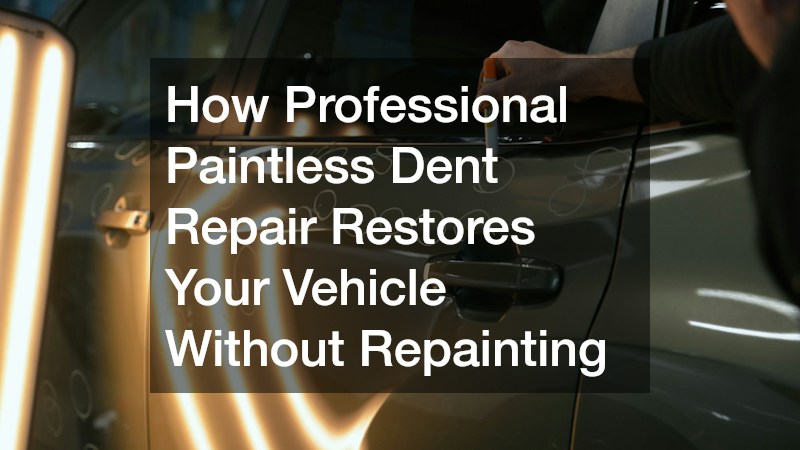
Discovering a fresh dent on your vehicle—whether from a stray shopping cart, a careless door swing, or an unexpected hailstorm—is frustrating. For decades, fixing even a minor crease meant taking your car to a traditional collision center, leaving it there for days, and paying for sanding, body filler, primer, and fresh paint. Today, however, professional paintless dent repair offers a faster, cleaner, and far more cost-effective alternative that restores damaged panels to their original factory shape without touching a drop of paint.
The Science Behind Metal Memory
Modern automotive body panels are made from high-strength steel or lightweight aluminum alloys engineered with a property known as “metal memory.” When a panel is stamped into shape at the factory, its molecular structure is formed to hold that exact contour.
When an impact creates a dent, the metal stretches and deforms inward, yet it retains a natural tendency to return to its original profile if manipulated properly.
Paintless dent repair works alongside this natural elasticity rather than covering it up. Because modern automotive clear coats and urethane-based paints are remarkably flexible, they rarely crack during minor or moderate impacts. As long as the paint surface remains unbroken, a skilled technician can massage the metal back into its factory position while leaving the original finish completely intact.
Specialized Tools and Precision Lighting
Restoring a dented panel without fillers requires far more than brute force; it demands surgical precision and specialized equipment. Technicians rely on an array of stainless-steel rods, whale tails, and soft-tipped tools designed to reach behind body panels through existing factory access points, such as window openings, taillight housings, or inner fender liners.
Equally important is the lighting used during the process. Standard shop lighting cannot reveal subtle ripples or microscopic high spots in a curved door panel. Instead, technicians use specialized LED reflection boards or line boards that cast parallel stripes across the painted surface. Wherever the metal is deformed, those reflected lines bend or pinch together. By watching how the lines shift in real time, the technician can pinpoint the exact center of the dent and apply controlled pressure millimeter by millimeter until the lines run perfectly straight again.
Step-by-Step: What Happens During the Process

Although every dent has its own geometry, a professional restoration generally follows a methodical sequence:
First, the technician thoroughly cleans the affected panel and inspects the damage under an LED board to confirm that the clear coat has not fractured and that the metal has not been stretched beyond its elastic limit. Next, they gain access to the backside of the panel, carefully removing interior trim pieces or tail lamps if necessary without disturbing factory seals.
Using gentle, calculated pushes from behind, the technician works from the outer edges of the dent inward, gradually releasing tension in the metal. When a dent is located over a double-walled panel or structural brace where rear access is blocked, technicians use a technique called glue pulling. Specialized thermoplastic glue tabs are adhered to the exterior paint, pulled outward with a slide hammer or mini-lifter, and safely released with an alcohol solution. Finally, a tapping-down tool is used to level any tiny high spots, restoring a smooth, mirror-like reflection.
Why Preserving Factory Paint Matters
Choosing paintless dent repair over conventional bodywork provides major long-term benefits beyond convenience. Factory paint is baked onto bare metal at extreme temperatures in a dust-free robotic environment, creating a durable bond and uniform thickness that aftermarket spray booths simply cannot replicate.
When a panel is sanded and repainted at a collision shop, you risk subtle color mismatches, orange-peel texture differences, or premature peeling years down the road. Furthermore, repainting a panel often triggers a diminished-value entry on vehicle history reports, lowering your car’s trade-in or resale price. Keeping your original finish intact preserves both structural corrosion protection and full market value.
Knowing When Paintless Repair Is the Right Fit
While paintless methods can resolve a surprising range of damage—including hail dings, rounded creases, and medium-sized body line dents—not every blemish qualifies. If the impact has chipped, cracked, or deeply scratched the paint down to the bare metal, traditional refinishing will be necessary to prevent rust. Similarly, dents located along the extreme folded edge of a door or quarter panel may lack the flexibility required for clean reshaping.
By combining an understanding of metal memory with specialized pushing tools, glue-pulling systems, and precision LED lighting, skilled technicians can erase unsightly dings while keeping your vehicle’s factory finish completely undisturbed. For drivers dealing with minor collisions, parking lot mishaps, or storm damage, this non-invasive method saves valuable time, eliminates costly repainting, and protects your car’s long-term resale value. When your vehicle suffers an unexpected impact, having a certified specialist evaluate the panel first ensures you get the cleanest, most economical restoration possible.